
[ad_1]
We all know the “Alphabet Song.”
If I asked you to recite the 26 letters of the English alphabet without the melody—just speaking them in a monotone rhythm—you would likely stumble. You would have to think about it. But if you sing it? It’s automatic. It’s hardwired.
This is the “Schoolhouse Rock” effect. Neuroscientists have known for decades that melody and rhythm are the most effective “zip files” for the human brain. Music transforms dry data into sticky memories.
For years, educators have tried to harness this. They have searched YouTube for “songs about the periodic table” or “songs about irregular verbs.” Sometimes they get lucky. Usually, they find cringeworthy, low-quality videos that don’t quite cover the curriculum.
But in 2026, the classroom dynamic is shifting. We are no longer dependent on what other people have recorded.
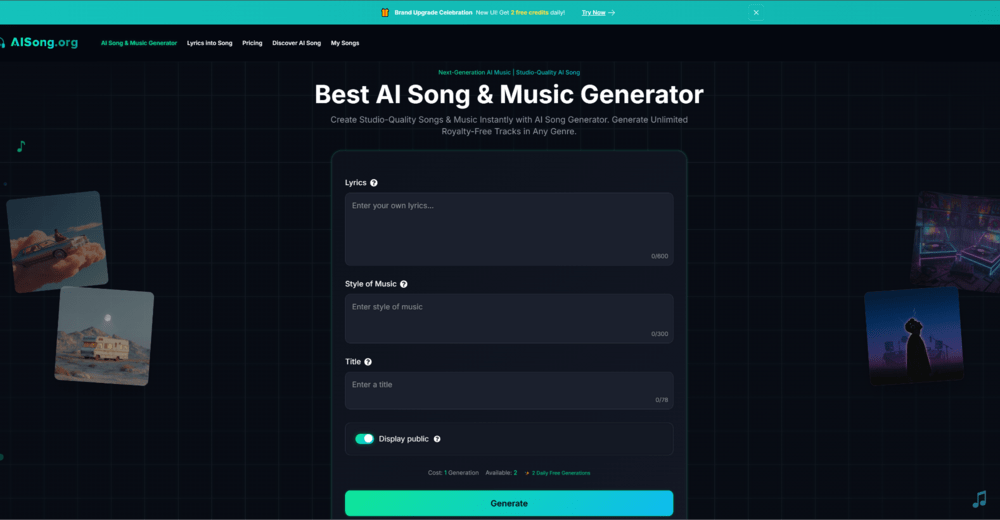
I have been testing the pedagogical applications of the AI Lyrics into Song engine, and I am convinced it is the most underrated EdTech tool of the year. It allows any teacher, tutor, or student to turn a textbook page into a catchy, memorable track in seconds.
Here is why this is the best tool for the modern learning environment.

The Science of “Mnemonic Audio”
Why does this matter? Because “Text-to-Speech” (TTS) is boring.
We have had TTS for years. A robot voice reading a history chapter is efficient, but it isn’t engaging. It doesn’t create an emotional hook.
In my testing of the AI Lyrics into Song platform, I found that it bridges the gap between information and entertainment.
- Rhythm as a Scaffold: When I inputted a list of Spanish vocabulary words and selected a “Reggaeton” beat, the AI naturally grouped the words into rhythmic clusters. This “chunking” makes it significantly easier for the brain to process and recall the list later.
- Intonation and Accent: Unlike standard TTS, which often sounds flat, the singing AI mimics the natural rise and fall of the target language (prosody). For language learners, this is crucial for understanding the “flow” of a sentence, not just the individual words.
Classroom Use Cases: Beyond the Gimmick
I initially approached this as a fun novelty, but after running several “curriculum tests,” the practical utility became clear.
1. The Language Lab Revolution
Learning a new language is mostly about repetition. But repeating a sentence 50 times is tedious. Singing it 50 times is fun.
- The Test: I inputted a complex French dialogue about ordering food in a restaurant. I chose a “French Chanson/Jazz” style.
- The Result: The AI produced a track where the dialogue sounded like a natural conversation set to music. A student listening to this isn’t “studying”; they are listening to a vibe. They are absorbing the pronunciation passively.
2. STEM Memorization
Biology and Chemistry are full of complex terms that are hard to memorize.
- The Strategy: You can paste the steps of “Mitosis” or the “Krebs Cycle” into the text box. Choose an aggressive “Punk Rock” or fast “Hyperpop” genre. The high energy forces the brain to pay attention.
- My Observation: The AI’s ability to fit long scientific words (like “Mitochondria”) into a beat is surprisingly competent. It adjusts the tempo to make the syllables fit the measure.
3. History and Literature
Imagine teaching Hamlet. Instead of just reading the “To be or not to be” soliloquy, you generate it as a “90s Grunge” track (capturing the angst of the character). Suddenly, the students connect with the emotion of the text, not just the archaic language.

Comparative Analysis: The “Engagement” ROI
How does this stack up against traditional teaching aids?
| Feature | Standard Textbooks/PDFs | YouTube Educational Videos | AI Lyrics into Song |
| Engagement Level | Low (Passive reading) | Medium (Passive watching) | High (Active listening) |
| Customization | None (Fixed content) | Low (Hard to find exact topics) | 100% (Your exact curriculum) |
| Cost | High (Publishers) | Free (with ads) | Free to start |
| Production Time | N/A | Hours to edit video | < 5 Minutes |
| Retention Style | Visual/Rote | Visual/Auditory | Mnemonic/Rhythmic |
| Accessibility | Requires reading focus | Requires screen time | Audio-only (Listen anywhere) |
A Workflow for Educators
If you are a teacher looking to implement this, here is the most effective workflow I have found to ensure the song actually helps with learning.
Step 1: The “Curriculum Script”
Don’t just paste a Wikipedia paragraph. The AI works best with structured text. Rewrite the lesson as a poem or a set of bullet points.
- Bad Input: “In 1492 Columbus sailed the ocean blue and he had three ships…”
- Good Input:
In fourteen hundred ninety-two
Columbus sailed the ocean blue
[Chorus]Niña, Pinta, Santa Maria
Sailing across the area
Step 2: Genre Matching
Match the genre to the energy of the class.
- Morning Class: Use “Lo-Fi Hip Hop” or “Acoustic” to gently wake them up.
- Post-Lunch Slump: Use “Electronic” or “Pop Punk” to inject energy into the room.
Step 3: The “Karaoke” Method
The platform allows you to generate the song, but you also have the text. Project the lyrics on the board while playing the generated track. This “dual-coding” (reading + listening) drastically improves literacy and retention.

Critical Limitations for Education
While this tool is powerful, it is not a replacement for a language tutor. Here is where you need to be careful.
- Accent Accuracy: While the AI is good, it is not always 100% native-level perfect. In language learning, there is a risk of the AI mispronouncing a nuanced vowel sound. It should be used as a supplement to native audio, not the only source.
- Speed of Delivery: Sometimes the AI sings too fast. If the goal is comprehension, you may need to manually add line breaks or punctuation in your text input to force the AI to pause and breathe.
- Distraction: If the music is too complex, students might focus on the beat rather than the words. I found that simpler genres (Folk, Country, Lo-Fi) work better for education than chaotic genres (Metal, Dubstep).
The Future of the “Custom Textbook”
We are moving toward a future where “Generic Learning” is dead. Every student learns differently.
The AI Lyrics into Song generator empowers educators to create custom learning assets on the fly. If a student is struggling with a specific concept, you don’t need to find a new book. You can write a 4-line rhyme, generate it as a song in their favorite genre, and send it to them.
It turns the teacher into a creator. It turns the lesson into a playlist.
In 2026, the best way to study for a test might not be highlighting a book. It might be putting on your headphones and listening to the album you generated for your history final.