
Home Blog Page 70

Journalist questions 31st Night Prophetic Extravaganzas

0

[ad_1]

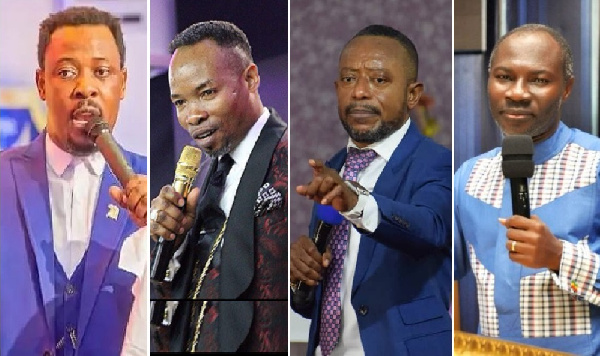
Journalist Gordon Asare-Bediako has challenged the growing obsession with New Year’s Eve prophecies, questioning why spiritual leaders wait until the final hours of the year to deliver messages that often carry heavy political undertones.

Speaking on Movement TV monitored by MyNewsGh.com, Asare-Bediako offered a candid critique of the 31st Night phenomenon, urging Christians to prioritise a consistent relationship with God over annual prophetic spectacles.

Asare-Bediako expressed scepticism regarding the sudden influx of divine messages during December 31st services, suggesting that the practice lacks logical spiritual consistency.

“I don’t put my hope in 31st night prayer because we have the whole year to make things right with God,” he stated. “Relying on the 31st night only does not make sense to me. Do the pastors record all the year’s prophecies and say them on the 31st night? Why do they have to wait till the 31st before they bring out all these prophecies?”

The journalist also took aim at specific claims made by high-profile clergy, specifically referencing Rev. Isaac Owusu Bempah’s alleged influence over electoral outcomes. He questioned why such purported spiritual authority is not applied to help their own close associates in local elections.

“If Rev. Owusu Bempah claims he has the spiritual power to reduce NPP’s vote in the Ashanti region, why could he not increase Charles Owusu’s, a leader at his church, vote at Nkoransa?” Asare-Bediako asked.

He further noted his surprise at the increasingly partisan nature of modern prophecy. “I am just surprised that the pastors who claim they are not politicians are always bringing political prophecies.”

While affirming his Christian faith and his belief in the supernatural, Asare-Bediako cautioned against “blind faith” in prophetic utterances, noting that dreams and visions are often subjective.

“I know for a fact that people dream and it comes true, and others dream and they do not come true; same applies to prophecies by these pastors,” he explained. “Even though I am a Christian, I do not fully believe in prophecies. If I am prophesied to, and it does not come to pass, I am okay. If it does, I am also okay.”

Asare-Bediako referenced Dr Tamakloe, urging prophets to stop making false prophecies about the political future of former President John Mahama. He joined the call for an end to speculative predictions that suggest unconstitutional outcomes.

“Pastors prophesying that President Mahama will go for a third term should stop,” he remarked, noting that while these instances are not new, they have persisted for too long in the Ghanaian religious space.

The journalist’s takeaway was a plea for discernment and a focus on core spiritual values rather than the sensationalism of the pulpit.

“I believe in spirituality,” he concluded, “but we do not have to put all our faith in these prophecies.”
[ad_2]

Historian traces the origins of prostitution in Kumasi-Adum to pre-independence era

0

[ad_1]

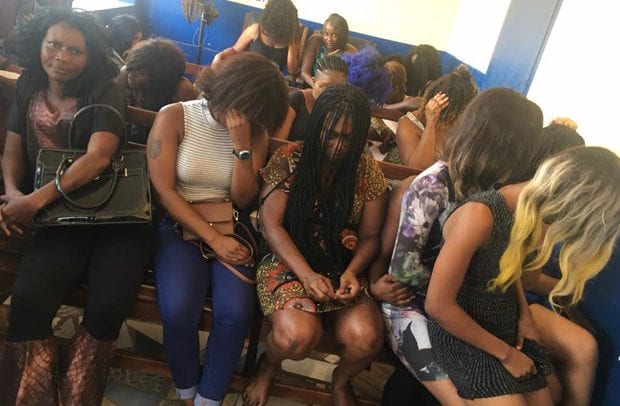
Popular historian Opanin Yaw Kyere has offered a historical account of how prostitution became associated with Kumasi-Adum, attributing its emergence to social developments dating back to the era of Ghana’s first President, Dr. Kwame Nkrumah.

Speaking on Ezra FM monitored by MyNewsGh.com, Opanin Kyere said many towns in Ghana are known for particular social or economic characteristics, and according to him, Adum in Kumasi gradually became known for commercial sex activities.

“Every town has something that makes it popular, and with Kumasi-Adum, it is prostitution,” he stated.

He contrasted Adum with other communities within the Kumasi metropolis, noting that similar activities were not prominent in places such as Bantama and Asafo.

“Prostitutes abound in Kumasi-Adum, but in areas like Bantama and Asafo, you do not find such things there,” he explained.

According to the historian, the practice in Adum can be traced to a woman popularly known as Maame Ataa Basie. He explained that in Akan culture, prostitution is traditionally referred to as “tutuu”, while in Ashanti specifically, the term “Basie bra” became associated with the practice because of the originator’s name.

Opanin Kyere said Maame Ataa Basie introduced the lifestyle during the time of President Kwame Nkrumah, recalling a public incident that later gained historical significance.

“During one of Kwame Nkrumah’s rallies in Adum, on a very hot afternoon, she mounted a platform and publicly announced that she wanted a man to spend the night with her,” he recounted.

He explained that although no man responded to her announcement at the time, the incident marked a turning point.

“After that, she went ahead to commercialise the act by renting out rooms in her house to people who later began engaging in such activities,” he said.

Opanin Kyere noted that Maame Ataa Basie herself was not actively involved in prostitution, largely due to her age, but became a central figure in organising and facilitating the practice.

“She was an older woman, so she was not directly involved, but she became known as the ‘Tutuu Hemaa’, the Queen of Prostitutes, because she controlled and managed the system,” he explained.

He added that Maame Ataa Basie hailed from Dabaa and was widely known at the time, describing her as a charismatic figure whose actions left a lasting imprint on the social history of Kumasi-Adum.

[ad_2]

Prepare a police uniform for me

0

[ad_1]

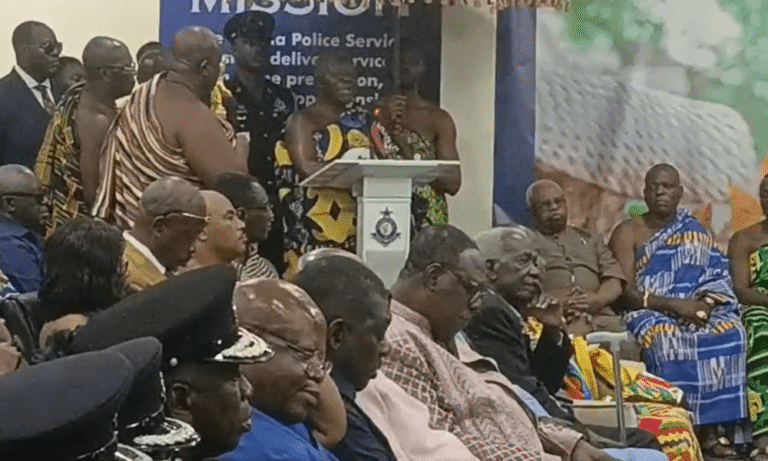
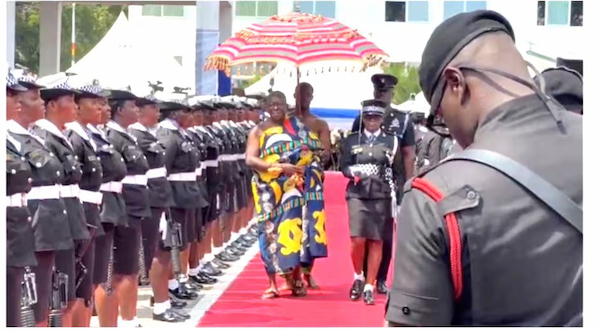
The Asantehene, Otumfuo Osei Tutu II, has praised the Inspector-General of Police, Mr Christian Tetteh Yohuno, for what he described as exemplary leadership during a visit to the Police Headquarters in Accra on January 6.

Addressing police personnel following a visit he paid to the Police Headquarters in Accra on January 6, the Asantehene expressed appreciation for the reception accorded him and his delegation.

“I appreciate the warm welcome accorded me and my entourage. I admire the women parade in their uniforms,” he said, drawing light laughter when he added, “Mr IGP please prepare a

Police uniform for me so that next time when I am coming, I will be in my Police dress.”

Otumfuo Osei Tutu II also used the occasion to announce a new initiative aimed at strengthening cultural awareness within the Service.

“I would like to announce that the Police administration will introduce a course on tradition and culture in our training programmes,” he stated.

He explained the purpose of the proposed course, noting that “this is to ensure that our officers understand the cultural context within which they operate.”

[ad_2]

Otumfuo is the King Solomon of our time

0

[ad_1]

Inspector-General of Police, Christian Tetteh Yohuno, has spoken highly of the Asantehene, Otumfuo Osei Tutu II, during his royal visit to the Police Headquarters in Accra on January 6.

The police boss signalled out his role in mediating conflicts and promoting peace across the country.

“Your exceptional mediation skills, which have restored peace in numerous conflicts across our nation, compel me to describe you as the King Solomon of our time,” Mr Yohuno said.

He attributed the resolution of several long-standing disputes to the Asantehene’s leadership and personal authority.

“Your wisdom, patience and moral authority have brought calm where tension once prevailed and unity when division once threatens our peace,” the IGP added.

During the engagement, it was also announced that the Police Service would take steps to deepen officers’ understanding of Ghana’s social environment.

“I would like to announce that the Police administration will introduce a course on tradition and culture in our training programmes.

“This is to ensure that our officers understand the cultural context within which they operate,” Mr Yohuno stated.

In response, the Asantehene commended the Inspector-General of Police for what he described as exemplary leadership, acknowledging the role of the Police administration in maintaining law, order and public confidence.

[ad_2]

Sack GNFS PRO now, he is unfit

0

[ad_1]

The Ghana Journalists Association (GJA) has called for the immediate removal of DO II Desmond Ackah, the Head of Public Relations for the Ghana National Fire Service (GNFS), following the alleged assault of journalist Samuel Addo.

Albert Dwumfuo, GJA President, spoke to journalists in Accra on January 6, saying, “We also call for the immediate dismissal or removal of the PRO of the GNFS from the position because our interactions with him on the case shows that he is unfit to be in charge of communication for the Fire Service.”

The association criticized the GNFS for offering an explanation they consider inadequate. “The claim that the officers did not assault the journalist but merely seized his phone because he was recording an altercation without permission is untenable, misleading and offensive to basic intelligence,” Dwumfuo stated.

He described the conduct of the fire personnel as reflecting a “dangerous culture of impunity” that must be confronted decisively. “No emergency or security institution has the authority to intimidate, assault or obstruct journalists under the guise of operational control,” he said.

The GJA President urged that the case be treated as a criminal matter to serve as a clear deterrent. “Internal disciplinary measures alone are insufficient. This is a criminal matter that must be tested in a court of law,” he explained, noting that Addo had formally filed a report at the Kasoa New Market Police Station.

Dwumfuo also recognized those who publicly condemned the assault. “We commend government through the Minister of State in charge of Government Communications, Felix Kwakye Ofosu, for the condemnation of the assault on Samuel Addo. We pray to see swift action on the case,” he said.

He further praised Class Media Group for their support of the journalist. “We also applaud the management and the CEO of Class Media Group, Seidu Adongo, for coming out boldly with a statement to condemn the attack,” Dwumfuo added.

[ad_2]

IGP promotes 30 officers for seizing AK-47 Ammo and dismantling robbery syndicate

0

[ad_1]

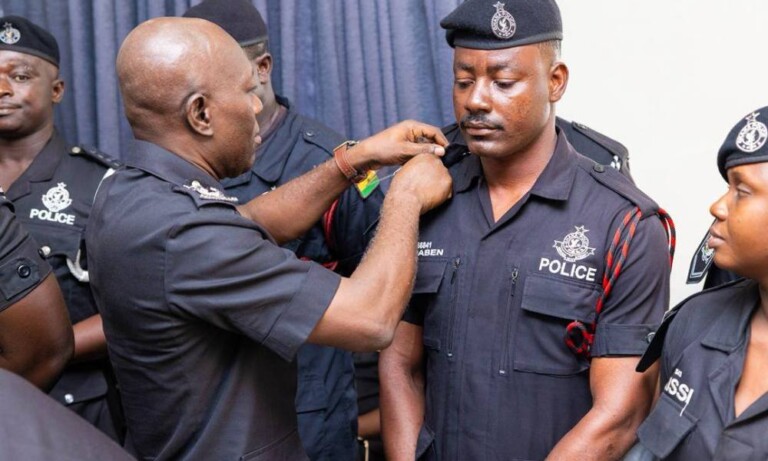
The Inspector-General of Police (IGP), Mr. Christian Tetteh Yohuno, has promoted thirty officers in recognition of their performance in operations that led to the seizure of 2,600 AK-47 rounds and the dismantling of a robbery syndicate in the Ashanti Region.

The promotions, announced on 5th January 2026 via the Ghana Police Service social media handle, were given to officers involved in the Kantanso Asankare Police Barrier operation and intelligence-led activities across Antoakrom–Manso Nkwanta and surrounding areas.

“The officers’ professionalism, vigilance, and commitment to duty have contributed significantly to public safety,” the IGP stated.

During the Kantanso Asankare operation, police officers conducted a search of a bus and recovered two containers concealing 2,600 rounds of AK-47 ammunition. They also found a bag under the driver’s seat containing two bulletproof plates, a black helmet, and a pair of long boots.

Officers promoted for the Kantanso Asankare operation include C/Inspector Tibim Acheampong Solomon, Inspector Sarfo Adu Daniel, and several constables, including Saeed Frimpong, Sremsei Simon, and Christian Buaben Kwadzo Addo.

An additional twenty officers from the Intelligence Department of the Ashanti and Ashanti South Regional Commands received promotions for their role in disrupting armed robbery activities, recovering firearms and ammunition, and preventing planned attacks on commuters.

The IGP, together with members of the Police Management Board, commended the officers for their courage and alertness. “Your actions prevented dangerous weapons from falling into criminal hands,” he said, urging all personnel to maintain high standards of professionalism. He added that the Police Administration will continue to acknowledge and reward diligent service.

[ad_2]

They took my phone and tore my belt

0

[ad_1]

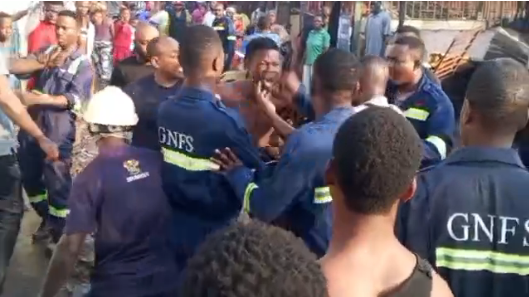
Class Media journalist Samuel Addo has shared the ordeal he suffered at the hands of the Ghana National Fire Service (GNFS) while covering a fire outbreak at the Kasoa New Market.

“They held my neck, pulled my hands behind my back, and assaulted me,” Addo told Citi News, describing the incident as he arrived at the station to seek the GNFS’s perspective after reporting on the market fire for a morning show.

He said the altercation began when a single officer approached him while filming a confrontation between officers and civilians.

“After I identified myself as media, the officer walked away, only to return minutes later with about ten colleagues,” Addo explained.

Addo further described how his equipment and personal items were taken. “They took my phone, tore my belt, and took both away,” he said.

Before his statement, Minister for Government Communications Felix Kwakye Ofosu condemned the assault, calling it unacceptable.

“The attack on Class Media Group’s Samuel Addo by some personnel of the Ghana National Fire Service is most unacceptable and I condemn same. Firm action will be taken against the rogue elements who carried out this attack,” he said in a statement.

The incident reportedly occurred as GNFS officers were engaged in a heated confrontation with traders while responding to a distress call, intensifying tensions at the scene. accountable.

[ad_2]

Cape Coast Assembly presents development plans to Vice President

0

[ad_1]

The Vice President, Jane Opoku-Agyemang, on Thursday received a delegation from the Cape Coast Metropolitan Assembly, led by the Metropolitan Chief Executive (MCE), George Arthur. The visit also included Members of Parliament for Cape Coast North and Cape Coast South.

According to the Vice President, the delegation extended New Year’s greetings and shared hopes for “strength and clarity to continue resetting the nation.”

During the meeting, the assembly presented an eight-year development plan for the Cape Coast Metropolis. The plan highlights the refurbishment and eventual operation of the Evans Atta Mills Library, alongside the rehabilitation of the Cape Coast Metropolitan Hospital.

The Vice President said discussions focused on making Cape Coast “more vibrant and economically viable,” while also considering the role of local fundraising initiatives in supporting the metropolis’ development.

She emphasized the importance of community involvement, urging the assembly to “involve the people of Cape Coast in their decision-making as much as possible, so that they have ownership of these initiatives and are willing to work toward change.”

She added that while efforts to develop Cape Coast are commendable, it is important that “they should not lose sight of the development of the entire nation.”

[ad_2]

Expose false Prophets – Rev. Emmanuel Boachie urges Church leaders

0

[ad_1]

In the wake of a wave of “doom prophecies” delivered during New Year’s Eve services, Rev. Emmanuel Boachie, Country Director of Awesome Bible College and Head Pastor of Souls Pasture Church, has called on genuine Christian institutions to take a stand.

Speaking in an interview on Ezra FM monitored by MyNewsGh.com, the clergyman argued that the rise of fear-based predictions is a scripted sign of the biblical end times and must be met with active exposure by the “true church”.

Rev. Boachie suggested that the public should not be surprised by the influx of controversial prophecies, as they align with scriptural warnings about the final days.​

“There is nothing we can do about such prophecies happening,” Rev. Boachie stated. “This is because they are prophecies that the Bible has mentioned; the Bible has made it clear that in the end times, there will be lots of false prophets. What we are seeing is a result of that.”

Rather than reacting with fear, the Reverend noted that these occurrences should serve as a spiritual wake-up call for the public to refocus their faith.

“This is proof that the coming of Christ is near and that people should begin seeking Him,” he added.

However, he placed the burden of responsibility on established, Bible-based churches to protect the public from exploitation. According to Boachie, it is no longer enough to remain silent; genuine leaders must actively distinguish themselves from those spreading messages of doom.

“The only thing that can be done is that the good churches that worship and practice the actual teachings of Christ by following the Bible must expose these false prophets,” Boachie urged. “They must also make the people know that they are the true prophets of God.”

Rev. Boachie emphasised that the primary goal of this exposure is to provide the public with a clear choice. He believes that once the mask is removed from false practitioners, the “right path” will become obvious to seekers.

“If people are able to differentiate between these two, the true prophet and the false prophet, they would follow the right path,” he explained.

Rev. Boachie concluded by stating he would take personal responsibility for the spiritual safety of his own congregation to ensure they are not led astray by sensationalist figures.

“I won’t allow any of my church members to worship with just prophets,” he remarked, signalling a move towards stricter doctrinal discipline within his ministry.

[ad_2]

 Politicians fuelling false prophecies –  Rev. Emmanuel Boachie

0

[ad_1]

Rev. Emmanuel Boachie of the pastor of Souls Pasture Church, has shifted the spotlight of the “doom prophecy” debate away from the pulpit and towards the political corridors of power.

Speaking on Ezra FM in Kumasi monitored by MyNewsGh.com, the clergyman asserted that the proliferation of sensationalist 31st Night prophecies and other false prophecies is a direct result of politicians seeking spiritual validation.

According to Rev. Boachie, the influence of these controversial prophets would diminish significantly if the country’s political elite were not propping them up.

Rev. Boachie argued that the prominence given to “doom prophets” is an artificial creation of political association. He suggested that by frequenting these churches and seeking public endorsements, politicians provide a platform that these figures would otherwise lack.

“False prophets are not the problem, but politicians,” Rev. Boachie stated bluntly. “It is these politicians that move to the prophets, giving them prominence in the country. If these politicians stop associating themselves with these prophets, all these things will stop.”

Beyond the political ties, Rev. Boachie levelled a serious allegation against the operational methods of these modern-day seers. He claimed that many of the “revelations” delivered on the 31st Night are not divine in origin, but are instead the result of investigative work done by church staff.

“These prophets use their young workers to find information on others in order to prophesy to those same people,” he alleged.

The Reverend expressed frustration with what he perceives as a collective refusal to address the root causes of this religious phenomenon. He noted that while many are aware of these tactics, there is a hesitation to speak out against the status quo.

“All these things are happening, but people are refusing to talk about it,” he remarked, calling for more transparency in how religious and political figures interact.

[ad_2]