


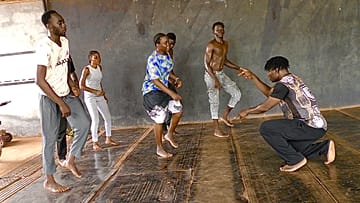
In Bobo-Dioulasso, Burkina Faso, a troupe of dancers is moving to music they cannot hear.
They are members of the Fientan Company, and every step, spin, and gesture is guided by something called Vibra-Signe — a dance technique created specifically for deaf and hard-of-hearing artists.
Founded in 2018 by choreographer Yaya Sanou, Fientan is the first contemporary dance company in Burkina Faso made up entirely of deaf and hard-of-hearing dancers. In less than a decade, it has gone from a neighborhood project to an internationally recognized group, winning gold for dance creation at the 9th Francophone Games in Kinshasa.
Growing up, he said, dance and music were everywhere in his community. Drums, djembes, celebrations. But his deaf and mute neighbors were always watching from the outside.
He noticed that when you dance barefoot on a terrace or floor, you feel the music before you hear it. A drum hits, and a vibration travels up through your feet, your legs, your spine.
“One feels specific vibrations — a resonance rising from the ground,” he says. “I try to link that resonance with the music playing, the dance, and the sign language being used, all while tapping the dancer’s body, enabling them to feel and capture the musical tempo.
The name combines two ideas: vibration — feeling music through the body and floor — and signe — sign language, which is used to “sign” the choreography and communicate timing, emotion, and counts.
To an audience, a Fientan performance looks like any other contemporary dance piece. The dancers move in sync to drums and djembes. They hit accents together. They breathe together.
Sanou and assistant coaches use physical touch to cue dancers — a tap on the shoulder, a pressure on the back. They watch each other closely. Because sign language is part of the rehearsal process, the dancers can discuss choreography visually, without needing an interpreter to translate spoken notes.
And because they dance barefoot, they stay connected to the floor. The vibration of a djembe isn’t just sound. It’s information.
“It’s sight, touch, and feeling combined,” Sanou says. “Sign language allows us to ‘sign’ the dance, and sight allows us to see and execute the movements.”
The result is precision without sound. A group that can stay together not because they hear a count, but because they feel it in their bodies.
“When I dance, I am very happy,” says dancer Sanou Waramata. “Dance really helps me flourish, interact, communicate, and share my story; I feel truly free.”
That idea — telling one’s story, communicating, flourishing — is at the center of the company’s work. Many of the dancers grew up being told what they couldn’t do. On stage, they decide what they can.
Their signature piece, Adepte de mon être — “Devotee of My Being” — is about exactly that. It explores their experiences as deaf people in society, the barriers they face, and the act of reclaiming space.
It was this work that earned them the gold medal for dance creation at the Francophone Games in Kinshasa. International audiences who had never heard of Vibra-Signe left talking about it
Vibra-Signe didn’t appear in a vacuum. Across the world, deaf dancers and musicians have long found ways to experience rhythm — through floor speakers, through interpreters, through visual cues.
What makes Fientan’s approach distinct is how rooted it is in Burkinabe culture. The company uses traditional instruments. The movement vocabulary draws from contemporary dance, but the pulse comes from local music tradition
In my tradition, we’ve always danced; we grew up with music. So I asked myself: what do I need right now to dance along with the music?”
By building the technique around touch and vibration, he created something that feels both new and familiar to the community it came from.
Beyond One Troupe
Today, Fientan Company is based in Bobo-Dioulasso, but its influence is spreading. Dance teachers and disability advocates have reached out to learn about Vibra-Signe. The company has performed abroad and uses each tour to show that deafness is not a barrier to professional dance.
The work is also changing conversations at home. In a country where resources for people with disabilities can be limited, Fientan offers a visible example of artistry, discipline, and leadership coming from the deaf community.
Sanou is careful not to call it charity.
“This came out of a need to have them dance to music, just as in my culture,” he says. “Little by little, I started tuning in to the rhythm of the music, and that sparked ideas and reflections. Gradually, I began developing the technique.
Watch a Fientan rehearsal and you’ll see what Sanou means. Drummers play. The floor vibrates. Dancers close their eyes for a second, feel the beat travel up, then open them and move. A tap on the arm means “now.” A sign means “softer.” A look across the room means “together.
For audiences, it’s a reminder that music isn’t only heard. It’s felt. Rhythm lives in the body before it reaches the ear.
And for the dancers, it’s proof that when one door closes, another opens — sometimes through the floor beneath your feet.
As Burkina Faso’s cultural scene continues to grow, Fientan Company is carving out a space that didn’t exist before 2018. Not just for deaf dancers, but for a new way of thinking about how we connect to sound, to each other, and to dance itself.
Vibra-Signe started as one man’s answer to a neighborhood need. Now it’s a technique, a company, and a story about what happens when you stop asking “can they and start asking


