


Home Blog Page 81

Attack on GoldBod is about Sammy Gyamfi, not losses

0

[ad_1]

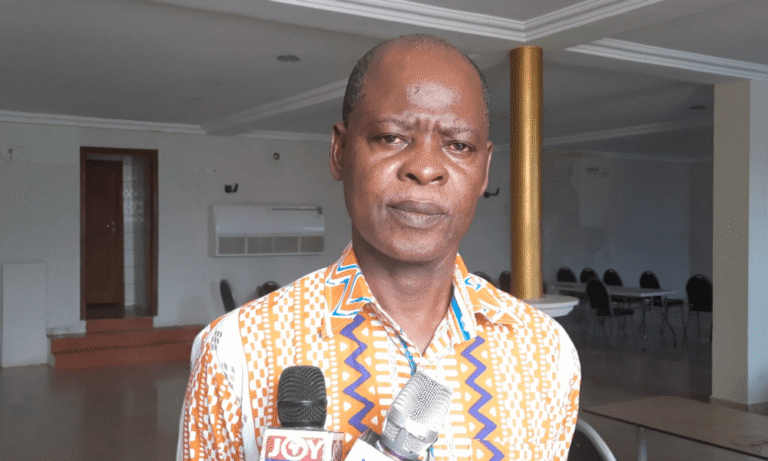
Policy analyst and communication strategist Dr. Emmanuel Steve Asare Manteaw has described recent criticism of GoldBod and its Chief Executive Officer, Sammy Gyamfi, as politically motivated and rooted in personal attacks rather than institutional failure.

Speaking on Metro TV’s Good Morning Ghana monitored by MyNewsGh, Dr. Manteaw said he recently listened to an interview granted by Sammy Gyamfi and sensed growing frustration over what he described as a deliberate attempt to discredit the institution.

“He sounded a bit frustrated with what appears to be an attempt to demonise the institution,” he said, noting that Gyamfi had repeatedly referenced improvements made compared to past operations.

According to Dr. Manteaw, the sustained criticism has little to do with performance.

“I think the attack on the GoldBod is all because of Sammy Gyamfi. If you put another person there, all this noise will stop,” he stated.

He attributed the backlash to envy and urged the GoldBod CEO to remain focused.

“It can be frustrating when you are doing something with the best of intentions, and you find people trying to distract you from your mission,” he said.

Offering words of encouragement, Dr. Manteaw described Gyamfi as capable and widely supported.

“He’s a very smart guy. He’s doing a good job. He should remain focused. He’s got the majority of Ghanaians behind him and should not be distracted by the very few people making so much noise,” he added.

[ad_2]

Sammy Gyamfi in Fresh Trouble Over US$10Bn Gold Bought Via Bawa Rock Ltd

0

[ad_1]

The Minority in Parliament has raised serious concerns over the country’s gold aggregation arrangements, alleging that a single private company, Bawa-Rock Limited, owned by Alhaji Rashid Bawa, has exclusively purchased gold worth more than US$10 billion on behalf of GoldBod and the Bank of Ghana over the past nine months.

According to the Minority, Bawa-Rock Ltd is purportedly the only company licensed to aggregate and purchase all artisanal gold supplied to GoldBod nationwide.

The Minority argues that this situation raises troubling questions about transparency, competition, and governance in Ghana’s gold sector.

In a statement circulated publicly, the Minority said it has formally posed seven critical questions to the authorities, none of which, it claims, has been adequately answered.

These include how Bawa-Rock Ltd became the sole aggregator licensed by GoldBod to buy artisanal gold directly from suppliers across the country, why a de facto monopoly was created in an industry where competition is meant to ensure fair pricing and prevent rent-seeking, and who ultimately benefits from what it describes as a deliberate and needless monopoly.

The Minority is also demanding clarity on who selected Bawa-Rock Ltd for this role, the criteria used in making that selection, and the identity of the company’s beneficial owners. Further, it questions why every miner, dealer, landowner, and small-scale producer must pass through a single private entity before gold reaches GoldBod and, for reserve purposes, the Bank of Ghana.

The Minority claims that Bawa-Rock Ltd operates from a headquarters located around Roman Ridge in Accra and alleges that the premises are under heavy military guard. No official explanation has been provided for the reported security presence.

In addition, unconfirmed reports circulating in the public domain suggest that the company’s owner may be related to the President. These claims have not been verified, and government officials have so far declined to comment on them.

[ad_2]

Better to absorb losses than run a high-inflation economy – Manteaw

0

[ad_1]

Policy analyst Dr. Emmanuel Steve Asare Manteaw has argued that losses incurred under Ghana’s gold-backed policy interventions should be assessed within the broader context of economic stabilization rather than isolated financial figures.

Dr. Manteaw said public debate around an alleged GHC214 million loss linked to GoldBod activities ignores the macroeconomic impact of the program.

“I would rather make losses to stabilize our economy and lay the foundation for economic growth than to make no losses and yet have no impact on the macro economy,” he said.

He explained that avoiding losses at all costs could come with far more damaging consequences.

“You could make no losses and still run an economy with very high inflation, high exchange rates, high fuel prices, and everything else,” he noted on Metro TV’s Good Morning Ghana monitored by MyNewsGh.

Dr. Manteaw stressed that economic policy must be judged by outcomes, not optics.

“We’ve gotten to a point where the benefits of the GoldBod activities outweigh the losses,” he said, suggesting that the focus should shift from headline figures to long-term gains.

He cautioned against allowing public discourse to be driven by narrow interpretations of financial performance, particularly when broader stability is at stake.

“Sometimes, the question is not whether there is a loss, but what the loss is preventing,” he added.

According to him, policies that help stabilize inflation and exchange rates ultimately deliver more value to citizens than short-term balance sheet optics.

[ad_2]

Meet Alhaji Rashid Bawa Namoro The ‘Tang Palace Don’ Enjoying Monopoly At Goldbod

0

[ad_1]

Alhaji Rashid Bawa Namoro has emerged as a central figure in Ghana’s unfolding debate over gold aggregation and state gold purchases.

Alhaji is the owner of Bawa-Rock Limited, the company reported to have been licensed as the sole aggregator authorized by GoldBod to purchase gold from artisanal and small-scale miners on behalf of the state.

To date, the Tang Palace based Alhaji Bawa has bought over US$10Billion

Under the arrangement, Bawa-Rock Ltd is said to serve as the exclusive conduit through which artisanal gold is aggregated before being transferred to GoldBod and, ultimately, to the Bank of Ghana for reserve purposes. The scale and exclusivity of this mandate have drawn intense public and parliamentary scrutiny.

The Minority argue that concentrating aggregation rights in a single private entity is a monopoly in a sector traditionally sustained by multiple buyers and competitive pricing.

They contend that such a structure risks rent-seeking, weakens transparency, and exposes miners to unfavorable pricing and limited market choice.

Questions have also been raised about the process that led to Bawa-Rock Ltd’s selection, the criteria applied, and the company’s beneficial ownership structure.

[ad_2]

You pay more because others pay nothing

0

[ad_1]

Ghanaian policy analyst Sitsofe Mensah has criticised the country’s tax exemption framework, arguing that Parliament-approved waivers are directly increasing the financial burden on ordinary consumers.

According to Mensah, while citizens routinely pay multiple consumption taxes such as VAT, the National Health Insurance Levy, GETFund and sanitation levies, large corporations and politically connected investors are often granted exemptions that excuse them from similar obligations.

“You are paying double because someone else is paying zero,” Mensah stated in asocial media post sighted by MyNewsGh.

“From the kayayo to the salaried worker, everyone is taxed, while selected companies are officially excused.”

Mensah described what he termed a “free pass regime,” where investors negotiate tax waivers as a condition for operating in Ghana. He noted that such exemptions are frequently approved by Parliament through voice votes, without detailed public scrutiny.

“Our representatives sign these waivers shielded by a chorus of ‘Yeah,’” he wrote. “These companies import equipment, materials and vehicles worth millions and pay 0.00 Ghana cedis in duty.”

The analyst argued that the fiscal consequences of these exemptions do not eliminate government expenditure but instead redistribute the tax burden. When revenue targets are missed, he said, authorities resort to raising indirect taxes that affect daily consumption.

“When government looks at the deficit, the response is not to reverse exemptions,” Mensah said. “It is to increase VAT, tax mobile money, and tax sachet water.”

[ad_2]

IMF has warned Ghana for a decade over tax exemptions

0

[ad_1]

Policy analyst Sitsofe Mensah has linked Ghana’s recurring fiscal challenges to long-standing tax exemption practices repeatedly flagged by the International Monetary Fund (IMF).

Mensah noted that for over a decade, IMF country reports have identified tax waivers as a major source of revenue leakage, warning that Ghana loses billions annually through exemptions granted to firms that do not require fiscal support.

“For over 10 years, the IMF has said the same thing: stop giving free passes to people who don’t need them,” Mensah wrote. “For over 10 years, our leaders have responded, ‘We will review it.’”

According to him, the promised reviews have not materialised because the exemption framework serves political interests rather than economic necessity.

“The exemption regime is not a mistake,” Mensah stated. “It is a feature. It is how political favours are traded and how friends of the party are rewarded.”

Mensah argued that these waivers function as a form of state-sanctioned tax avoidance, authorised through legal processes but detached from public interest outcomes.

“It is legalised tax evasion for the connected,” he said, “signed and sealed by the very institution meant to protect the public purse.”

He further questioned why successive IMF programmes continue to focus on austerity measures affecting citizens while the structural causes of revenue loss remain intact.

“National expenses do not disappear when exemptions are granted,” Mensah said. “They are shifted onto those least able to pay.”

[ad_2]

That money existed – Sitsofe Mensah on the social cost of Ghana’s tax exemptions

0

[ad_1]

Policy analyst Sitsofe Mensah has linked Ghana’s declining public services to revenue lost through tax exemptions, arguing that waived taxes directly affect healthcare, education and infrastructure delivery.

According to Mensah, the term “tax waiver” often masks its real-world implications for citizens who rely on public services.

“When you hear ‘tax waiver,’ don’t think of economics,” he wrote. “Think of the incubator missing in your district hospital. Think of the textbooks your child never received.”

Mensah stated that taxes waived by Parliament represent funds that were legally owed to the state and budgeted for national development.

“That money existed,” he said. “It was owed to the state. It was waived away with a signature.”

He argued that the resulting funding gaps explain why essential services remain under-resourced despite consistent tax collection from consumers.

“The road that destroys your shock absorbers every month was not forgotten,” Mensah noted. “It was underfunded.”

Mensah also criticised the tendency to spiritualise economic hardship, especially during religious events at the end of the year.

“You cannot pray away a tax exemption signed in Parliament,” he wrote. “God provides the harvest; policy determines who eats.”

He concluded by urging citizens to shift from passive acceptance to political scrutiny, particularly of parliamentary voting records on tax exemptions.

“The prayer is yours,” Mensah stated. “But the receipt is theirs. Do not just say ‘Amen.’ Demand they show their hands.”

[ad_2]

No jobs, lack of drinking water, poor roads; Fodzoku chief recounts VRA’s failed promises

0

[ad_1]

The chiefs and people of Fodzoku in the North Tongu District of the Volta Region have expressed deep disappointment over unfulfilled promises following the government’s acquisition of more than 3,100 acres of their fertile lands for the construction of the Kpong Hydroelectric Dam.

The Kpong Hydro Dam, a run-of-the-river plant located downstream from the Akosombo Dam, currently generates nearly 150 Megawatts (MW), contributing significantly to Ghana’s national power supply. Despite this, the community says decades-old commitments have yet to be met.

At the climax of their annual Gligbaza festival on Saturday, December 27, 2025, the acting Paramount Chief and Manklalo of Fodzoku Traditional Area, Togbe Kwasi Misrobi III, outlined the persistent challenges faced by residents. These include limited access to safe drinking water, poor road conditions, and insufficient employment opportunities at the VRA.

“We were promised houses for the citizens of Fodzoku,” Togbe Misrobi III said. “We petitioned the Government and the VRA several times, but there has been no response. We are still expecting these houses to be built. Should this continue to fail, we are prepared to implement Plan ‘B’.”

He further criticised the VRA for not offering employment opportunities to locals, despite the organisation sponsoring some to pursue advanced degrees, including Masters and Ph.Ds, in fields relevant to the company’s operations. According to him, the lack of local jobs forces young people to leave the community in search of work in urban areas.

“…It would be a source of great pride if our young men and women could access opportunities within Fodzoku,” Togbe Misrobi III added. “Allowing them to work here after completing their training would enable them to contribute to the community’s growth.”

The Manklalo urged the VRA to fulfil its long-standing obligations, including constructing houses, providing toilet facilities, repairing roads and drainage systems, and considering qualified locals for employment opportunities.

Despite the frustrations, the chief acknowledged the VRA’s support for education and community events. He noted that the company continues to award scholarships to Fodzoku students at senior high school and tertiary levels and contributes to the annual Gligbaza festival with financial assistance.

Responding to the concerns, VRA Principal Community Relations Officer Mrs. Rhoda Arthur reaffirmed the organisation’s commitment to Fodzoku’s development. She encouraged traditional authorities to channel their requests and complaints through proper administrative procedures to ensure timely resolution.

[ad_2]

Govt addresses ECG worker concerns, highlights benefits of PSP

0

[ad_1]

The Ministry of Energy and Green Transition has called for calm and restraint following nationwide protests by workers of the Electricity Company of Ghana (ECG).

The statement, released on Tuesday, December 30, stressed that the Private Sector Participation (PSP) framework for ECG is not a sale but a strategy to strengthen operations.

“The Ministry calls for calm and restraint as engagements continue in good faith.

The selection of a transaction advisor is a technical and procedural step to properly structure the PSP framework and does not in any way constitute or imply an outright sale of ECG,” the Ministry said.

The Ministry outlined the government’s commitment to protecting the interests of ECG workers while ensuring the utility becomes more reliable, efficient, and sustainable.

“Government remains committed to protecting the interests of workers, strengthening ECG, and ensuring a reliable, efficient, and sustainable power sector for all Ghanaians,” the statement added.

The statement comes after the Public Utilities Workers Union (PUWU) led symbolic nationwide protests on December 29, including hoisting red flags and wearing red bands at ECG offices.

While these actions highlighted worker concerns, the Ministry emphasized that the PSP framework is aimed at operational improvements, deploying private sector expertise in strategic areas to enhance service delivery.

“The approved Private Sector Participation framework is not a sale or divestiture. Rather, it involves the strategic deployment of private sector expertise through multiple concession arrangements to support and improve specific operational areas of ECG,” the Ministry said.

[ad_2]

ECG will not be sold

0

[ad_1]

The Ministry of Energy and Green Transition has reiterated that the Government of Ghana does not intend to sell the Electricity Company of Ghana (ECG).

In a statement issued on Tuesday, December 30, the Ministry said the Private Sector Participation (PSP) framework approved for ECG is designed to improve operations, not to divest the state-owned utility.

“The Ministry emphasises unequivocally that the Government of Ghana does not intend to, and will not, sell ECG.

The approved Private Sector Participation framework is not a sale or divestiture.

Rather, it involves the strategic deployment of private sector expertise through multiple concession arrangements to support and improve specific operational areas of ECG,” the Ministry said.

The Ministry explained that the recent appointment of a transaction advisor is a standard procedural step, intended to structure the PSP framework efficiently.

“The selection of a transaction advisor is a technical and procedural step to properly structure the PSP framework and does not in any way constitute or imply an outright sale of ECG,” it added.

“Government remains committed to protecting the interests of workers, strengthening ECG, and ensuring a reliable, efficient, and sustainable power sector for all Ghanaians,” the Ministry concluded.

The clarification comes after workers of ECG staged nationwide symbolic protests on December 29, voicing concerns that the appointment could threaten the future of the utility.

While these demonstrations drew attention, the Ministry’s statement emphasizes that the PSP framework is intended to enhance operational efficiency rather than transfer ownership.

[ad_2]