


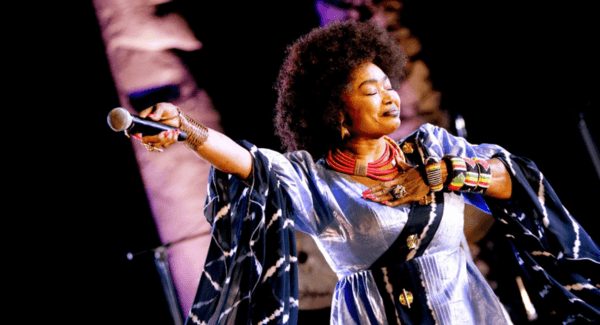
Malian music icon Oumou Sangaré is headlining this year’s WOMAD Festival in England, bringing with her decades of music rooted in the Wassoulou region of southern Mali and a career built around challenging attitudes toward women.
The 58-year-old singer is performing from July 23 to 26 at Neston Park in Wiltshire, where WOMAD is being held this year. For Sangaré, the appearance is another chapter in an international journey that began with a young girl singing to support her family in Bamako and grew into one of African music’s most respected voices
Sangaré’s story is closely tied to hardship and resilience. After her father left the family, she grew up in difficult financial circumstances. As a child, she sang to help her mother earn money to support the household.
Music quickly became more than survival. It became her voice. Her breakthrough came with her debut album Moussoulou, which means “Women.” The record did two things at once: it established Sangaré as a major artist in Mali, and it spoke openly about issues that were rarely discussed in popular music at the time.
Moussoulou challenged forced marriage, questioned gender inequality, and called for women to have more control over their lives. The album turned Sangaré from a local singer into a national figure, and soon after, into an international one.
Her sound is rooted in Wassoulou, a cultural region that spans parts of southern Mali and neighboring West African countries. Wassoulou music is known for powerful vocals, distinctive rhythms, and traditional instruments. Sangaré took that regional sound and introduced it to audiences far beyond West Africa.
Her international career gained traction after she connected with Malian legend Ali Farka Touré and later worked with the World Circuit record label. Over the decades she has played major festivals and concert halls around the world, while staying faithful to the musical language that first made her known
Sangaré’s songs repeatedly return to themes of independence, marriage, social expectations, and economic freedom. For her, these are not abstract ideas. They reflect what she saw growing up and the experiences of women around her.
She has spoken throughout her career about the importance of women being able to earn their own income and make decisions about their futures. That message has resonated across generations in Mali and in the wider African diaspora.
But Sangaré does not label herself only as an activist. She describes herself first as a musician. Her method has been to use songs to tell stories, ask difficult questions, and start conversations that might otherwise stay private.
“Tradition can be celebrated while still being questioned,” is a message listeners have come to associate with her work. She respects Wassoulou traditions, but she also uses them to examine practices that limit women.
Beyond music, Sangaré has put her ideas about independence into business. Over the years she has invested in ventures in Mali, including in hospitality and the automotive sector.
Her reasoning reflects a belief she has voiced often: empowerment requires economic opportunity. For many women, financial independence changes what choices are possible.
In Mali, Sangaré has become an example of how artistic success can translate into jobs and businesses outside entertainment. She employs people, runs enterprises, and uses her platform to talk about self-reliance.
That combination of music, entrepreneurship, and advocacy has made her influence extend beyond the stage.
Performing at a pivotal time
Sangaré’s WOMAD appearance comes as Mali continues to face serious challenges. The country has endured years of political instability and armed conflict, especially in the north and central regions. The violence has affected communities, businesses, and cultural life.
Yet Malian music continues to command international respect. From Ali Farka Touré and Salif Keita to Tinariwen and now Sangaré, Malian artists have played a central role in introducing global audiences to West African musical traditions.
For Sangaré, touring internationally also means keeping another image of Mali visible — one defined by creativity and culture, not only by conflict.
WOMAD, which brings together musicians, dancers and artists from around the world, has long been an important platform for African music. This year’s edition at its new home in Neston Park features artists from multiple continents, and Sangaré is among the headline names
Sangaré’s performance also arrives at a moment when African music is enjoying unprecedented global visibility. Afrobeats and amapiano dominate streaming charts, and African artists are headlining festivals and collaborating across genres.
But Sangaré represents a different, older thread of that global story. She built an international career while staying deeply connected to local language, instruments, and storytelling.
Her presence at WOMAD shows that audiences are still drawn to music rooted in specific cultural traditions, not only to contemporary pop fusions.
After decades of recording and touring, Sangaré says she is not finished. She continues to experiment musically and has hinted that new work is coming.
For her, the WOMAD set is not just a celebration of past achievements. It is a continuation of work that began in Bamako: using music to speak plainly about women’s lives, to preserve Wassoulou sound, and to remind audiences that culture can both honor tradition and question it.
As she takes the stage this week, that message travels again — from southern Mali to a field in Wiltshire, carried by one of the continent’s most distinctive voices.


