


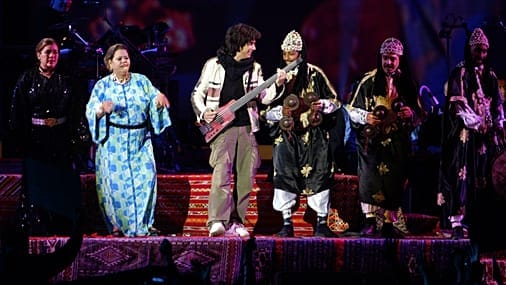
The blue-walled city of Essaouira came alive this week as the 27th edition of the Gnaoua and World Music Festival opened with its signature parade of Gnaoua brotherhoods. The procession through the UNESCO-listed medina set the tone for one of Morocco’s most influential cultural gatherings, drawing thousands of music lovers from across Africa and beyond
Founded in 1998 by producer Neila Tazi, the festival has grown from a local celebration into an international platform that places Gnaoua music at the center of a wider conversation about African heritage, displacement, and artistic collaboration
For Tazi, the event has always been about more than performance. It is a space to reclaim and highlight a musical tradition linked to communities descended from enslaved people brought to Morocco from sub-Saharan Africa.
“Africa is part of the festival’s DNA,” she said. “At the heart of the project is Gnaoua culture, which draws its roots from different countries in sub-Saharan Africa. It carries a long history of displacement and of artists descended from former slaves. It was important for us to highlight this aspect, which was overlooked for decades—a culture that was marginalized for far too long, despite having an extraordinary story to tell the world.”
Gnaoua music is characterized by hypnotic rhythms played on the guembri, a three-stringed bass lute, layered with metal castanets called krakebs, spiritual chants, and ritual movement. In 2019, UNESCO recognized Gnaoua as an Intangible Cultural Heritage of Humanity, noting its role in Morocco’s cultural identity and its links to West and Central African traditions.
One of the festival’s headline moments was the return of Cameroonian bassist Richard Bona, performing in Essaouira for the first time in eight years. Bona argued that African musical traditions, despite regional differences, speak a common language.
“Our African music has always shared common roots,” he said. “Whether it’s Gnaoua, Sabar, Bolobo, or any other African tradition—if you understand the grammar, you can easily read or understand the music. It all comes back to rhythm. Rhythm is something that is never foreign to us as Africans.”
That idea of a shared “grammar” has shaped the festival’s programming for nearly three decades. Instead of keeping Gnaoua in a silo, organizers pair Gnaoua maâlems, or masters, with artists from jazz, gospel, blues, hip-hop, and other African styles to create new works on stage.
This year’s edition continued that tradition of musical dialogue. Young Gnaoua master Mehdi Qamoum performed with the Harlem Spirit of Gospel choir, linking two traditions rooted in African ancestry and spiritual expression.
“Morocco and all Africa—we’re trying to bring all this music home, to play it with Gnaoua music,” Qamoum said. “And this is the definition of the Gnaoua and World Music Festival.”
The collaboration underscored a central theme: Gnaoua is both a specific Moroccan tradition and a node in a broader African musical network. Gospel’s call-and-response, Gnaoua’s trance-like grooves, and West African polyrhythms all trace back to rhythmic and vocal practices that traveled across the continent and the diaspora.
Over 27 years, the festival has evolved beyond concerts. It now functions as a site of cultural memory, artistic innovation, and exchange. For audiences, it is a chance to experience Gnaoua in its ritual context while seeing how it interacts with contemporary sounds. For artists, it is a laboratory to experiment, learn, and build cross-continental relationships.
The festival’s location matters. Essaouira, a historic port city on Morocco’s Atlantic coast, was a point of contact for traders, musicians, and migrants. Its medina, a UNESCO World Heritage site, provides an atmospheric backdrop that connects the music to place and history
Organizers say work has already begun on the 2028 edition, with plans for more collaborations that deepen links between Gnaoua and other African traditions. The goal is to keep expanding the festival’s role as a bridge, not just between Morocco and the world, but among African musical cultures themselves.
That forward-looking approach reflects the festival’s founding principle: to center a culture that was marginalized and to show its relevance to contemporary music.
It preserves the memory of communities formed by forced migration, keeping their music, language, and ritual practices alive.
- By pairing Gnaoua artists with musicians from different backgrounds, the festival models how heritage can be a basis for new creation rather than a museum piece
- From the opening parade of brotherhoods in their embroidered robes to late-night fusion sets, the Gnaoua Festival makes a simple but powerful case: rhythm is a common African inheritance. Whether it shows up as Sabar in Senegal, Bolobo in Central Africa, or Gnaoua in Morocco, the underlying pulse connects.
As Bona put it, once you understand that grammar, the music opens up. And once you hear Gnaoua alongside gospel, jazz, or other African forms, you hear family resemblances that history tried to separate.
For Essaouira’s residents and visitors, the festival is a week of music. For the continent, it is a reminder that African roots are not static relics. They are living traditions that continue to travel, adapt, and bring people together.
Preparations for the next edition are already underway, promising more artists, more collaborations, and more reasons to return to Essaouira’s seaside